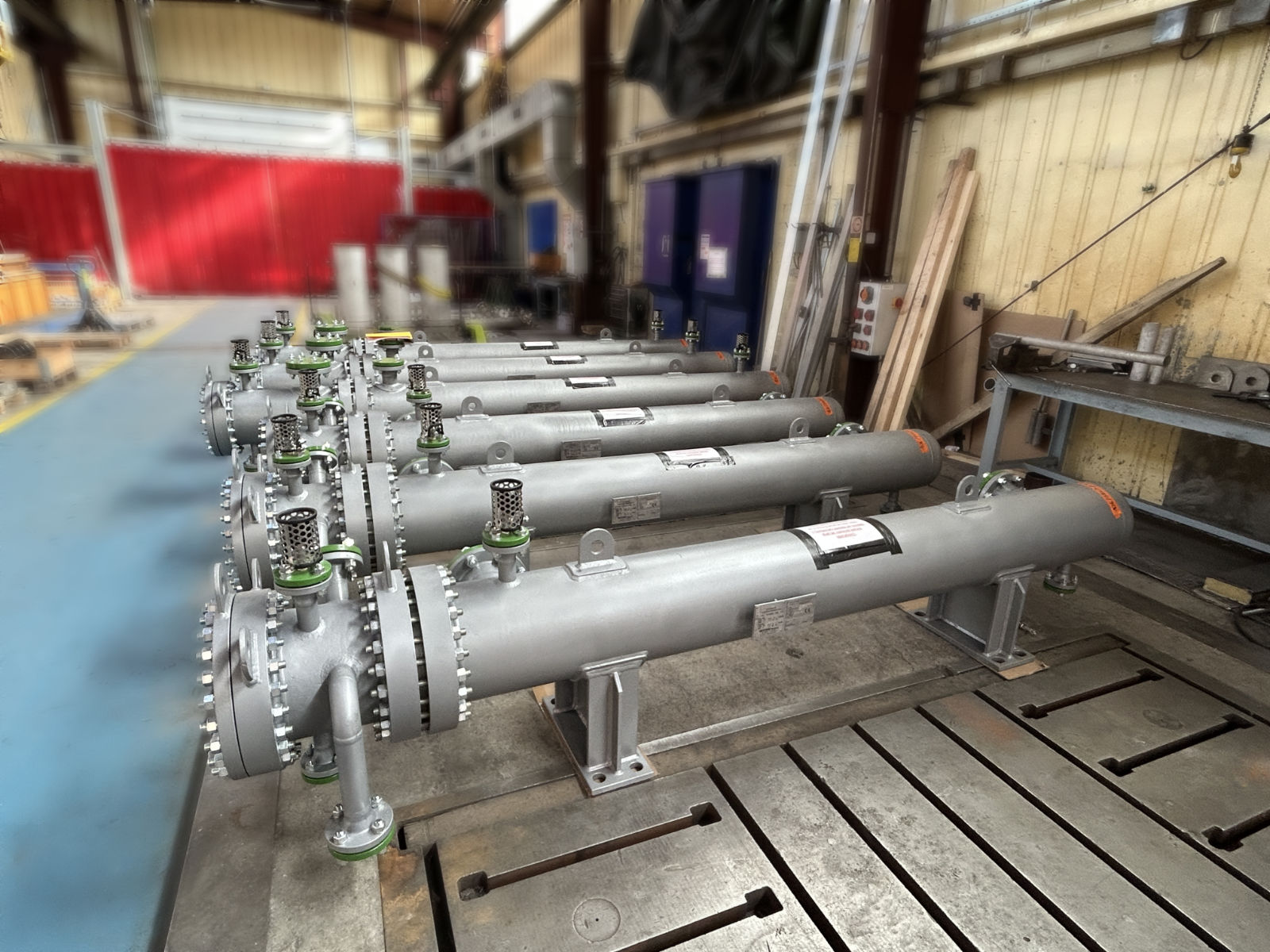
This large-scale project concerns the design and manufacturing of four batches of gas heat exchangers (12 units in total) equipped with U-tube bundles, intended for an industrial facility in Taiwan. This equipment required a rigorous technical approach combining advanced engineering, specialized calculations, and precision manufacturing according to the most demanding international standards.
The challenge began at the design stage, as it was necessary to create 4 similar designs but for 4 different types of equipment, within a very tight deadline.
Technical Specifications and Applicable Standards
Codes and Certifications
The project was carried out according to the following standards and certifications:
- ASME VIII Division 1: Construction code for pressure vessels
- U-Designator Certification Mark (formerly U-STAMP): Official ASME certification for manufacturing pressure equipment
- TEMA Type R: Specifications for heat exchangers (petroleum and heavy chemical applications)
- ATEX Classification: Compliance for use in explosive atmospheres
The project also required compliance with numerous client specifications both in terms of design and project management for these 4 tubular gas heat exchangers.
TEMA Configuration
The heat exchangers were designed according to different TEMA configurations:
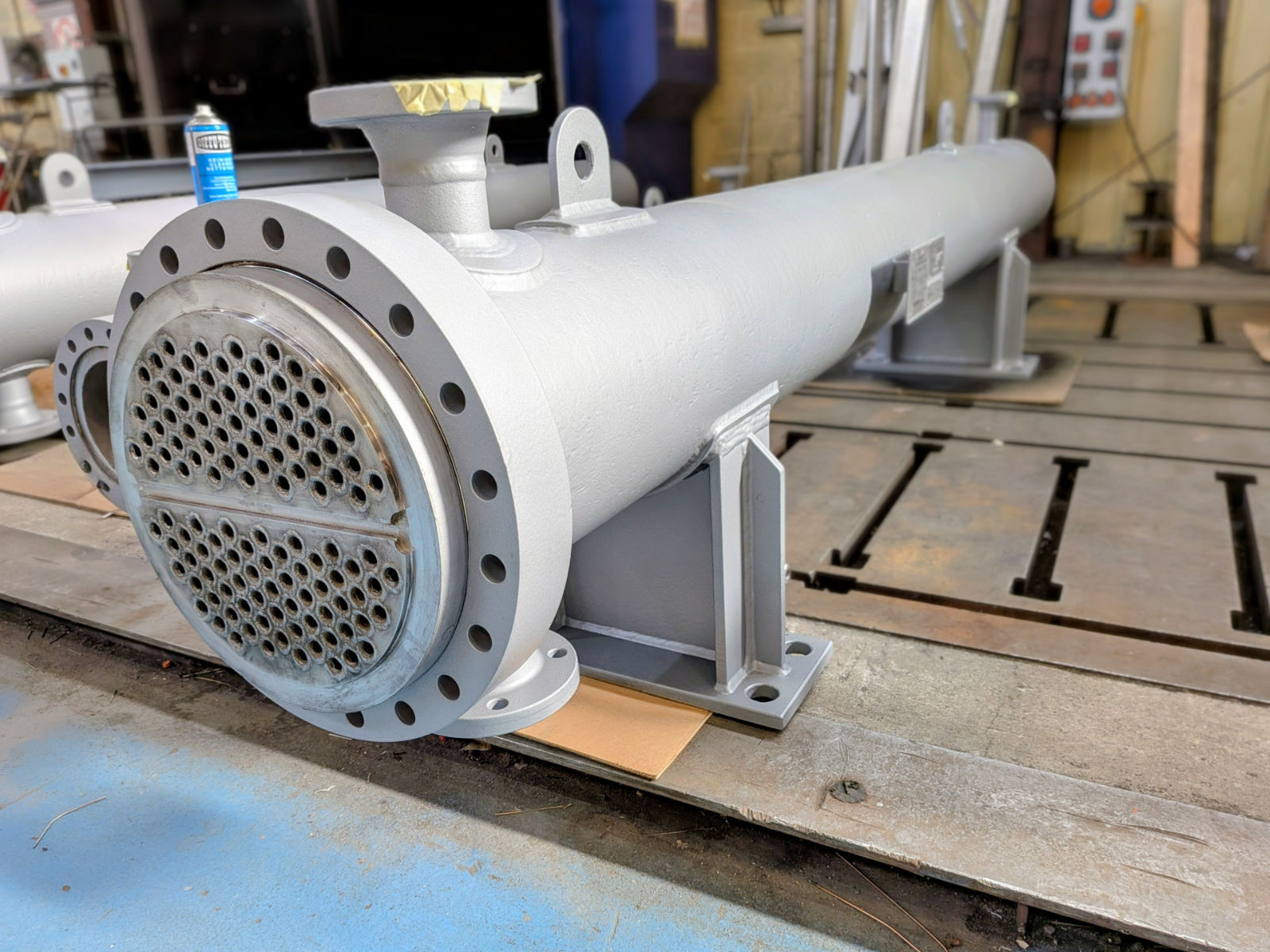
- Type AEU: Fixed front head (A), single-pass shell (E), U-bundle (U)
- Type AFU: Fixed front head (A), two-pass shell (F), U-bundle (U)
These configurations allow free thermal expansion of U-tubes while offering easy disassembly for maintenance of tubular heat exchangers.
Finite Element Method (FEM) Mechanical Calculations
All critical components underwent finite element analysis to validate the stress in the different parts and the behavior under pressure and temperature.
These FEM analyses optimized thicknesses and guaranteed structural integrity throughout the service life of the gas heat exchangers.
Seismic and Wind Calculations
Given the final destination in Taiwan, an area with seismic activity, specific calculations were performed:
- Seismic analysis
- Wind analysis
- Nozzle loads WRC 107 and WRC 537
- Resonance / vibration calculations
Collaborative Design on SolidWorks
The design of the four heat exchangers was carried out collaboratively using SolidWorks Product Data Management (PDM):
Project team: 3 designers working simultaneously
SolidWorks PDM advantages:
- Centralized CAD file management
- Task assignment and tracking by equipment and sub-assembly
- Version control and modification traceability
- Secure file sharing among Engineering Department members
- Prevention of modification conflicts
Collaboration with the Client
The U-tube bundle drawings were custom-developed in close collaboration with the client:
- Regular exchanges on installation constraints (baffling, bypass elimination)
- Validation of interfaces and overall dimensions (nozzle positions, support leg heights, anchor dimensions)
- Adaptation of configurations to specific process requirements (heat transfer validation, number of passes)
- Iterative revisions until final validation
- Sharing of 3D models in STEP format for verification
This collaborative approach optimized the design and ensured perfect integration of the heat exchangers into their on-site environment.
Materials and Special Requirements
- Forged steel tube sheets
- Chemical composition requirements for materials
- Welding neck shell flanges
Material Certificates
All components were supplied with compliant material certificates:
- Type 3.1 certificates according to EN 10204
- Complete traceability from casting
- Results of chemical analyses and mechanical tests
- Part-by-part marking
Enhanced Non-Destructive Testing (NDT)
A particularly rigorous NDT program was applied:
Radiography
- 100% radiography of all butt, longitudinal and circumferential welds
- Interpretation according to ASME Section VIII Div. 1
- Films archived for traceability
Liquid Penetrant Testing
- 100% penetrant testing of all welded surfaces after final machining
- Products certified to EN ISO 3452
- Inspection by qualified personnel minimum level 2
- Detailed report with inspection mapping
These exhaustive inspections guarantee the absence of defects and compliance with the ASME construction code.
Final Tests and Inspections
- Hydrostatic test at 1.5 times the working pressure
- Helium or ammonia leak test
- Final dimensional inspection with report
- Complete visual inspection
- ATEX Conformity
Conditioning and Shipping
Protection for Gas usage
Special precautions were taken:
- Thorough internal cleaning
- Elimination of all contamination
- Closure of all openings
Hermetic Nitrogen Packaging
To guarantee equipment integrity during transport:
- Nitrogen pressurization at 0.3 bar gauge
- Hermetic closing
- Pressure control gauges installed
- Protection against atmospheric corrosion
- Preservation of machined surfaces
SEI IV C Marine Crates
The four batches of heat exchangers were packaged in SEI IV C compliant marine crates:
- Crates made of reinforced marine plywood
- Protection against shocks and weather
- Marking according to international regulations (ISPM 15)
- Internal bracing adapted to dimensions and weight
- Protection of nozzles and accessories
Technical Documentation
A complete documentation package was provided including:
- General assembly and detail drawings (SolidWorks)
- Calculation notes (thermal, mechanical, FEM, seismic)
- Manufacturing report + ASME Certification
- Type 3.1 material certificates
- Complete NDT reports
- Hydrostatic test reports
- Operation and maintenance manual
Oeltechnik-France Expertise
This project illustrates Oeltechnik-France's capabilities:
- Engineering department equipped with SolidWorks with PDM
- ASME U-Designator Certification Mark (U-STAMP) certification
- ATEX certification
- Advanced calculation capability (FEM, seismic, vibrations)
- ISO 9001 qualification
- On-site manufacturing workshop
- Quality department for NDT and testing
- International experience
Conclusion
The design and manufacturing of these gas heat exchangers with U-tube bundles represent a highly complex technical project, combining:
- Advanced engineering with specialized calculations (FEM, seismic, resonance)
- Modern collaborative work via PDM
- Manufacturing and procurement according to ASME U-DESIGNATOR
- Exhaustive quality controls